Views: 0 Author: Site Editor Publish Time: 2026-07-21 Origin: Site


Organizations no longer just buy personal protective equipment reactively. They now take a strategic, compliance-driven approach to their procurement processes. Buyers understand proper quality management directly impacts long-term safety.
A Disposable Face Mask does not have an infinite shelf life, nor can it be worn indefinitely. Misunderstanding these precise limits leads to compromised safety, strict regulatory non-compliance, and ultimately wasted budgets. Facilities risk exposing their teams to preventable harm when they ignore scientific expiry dates.
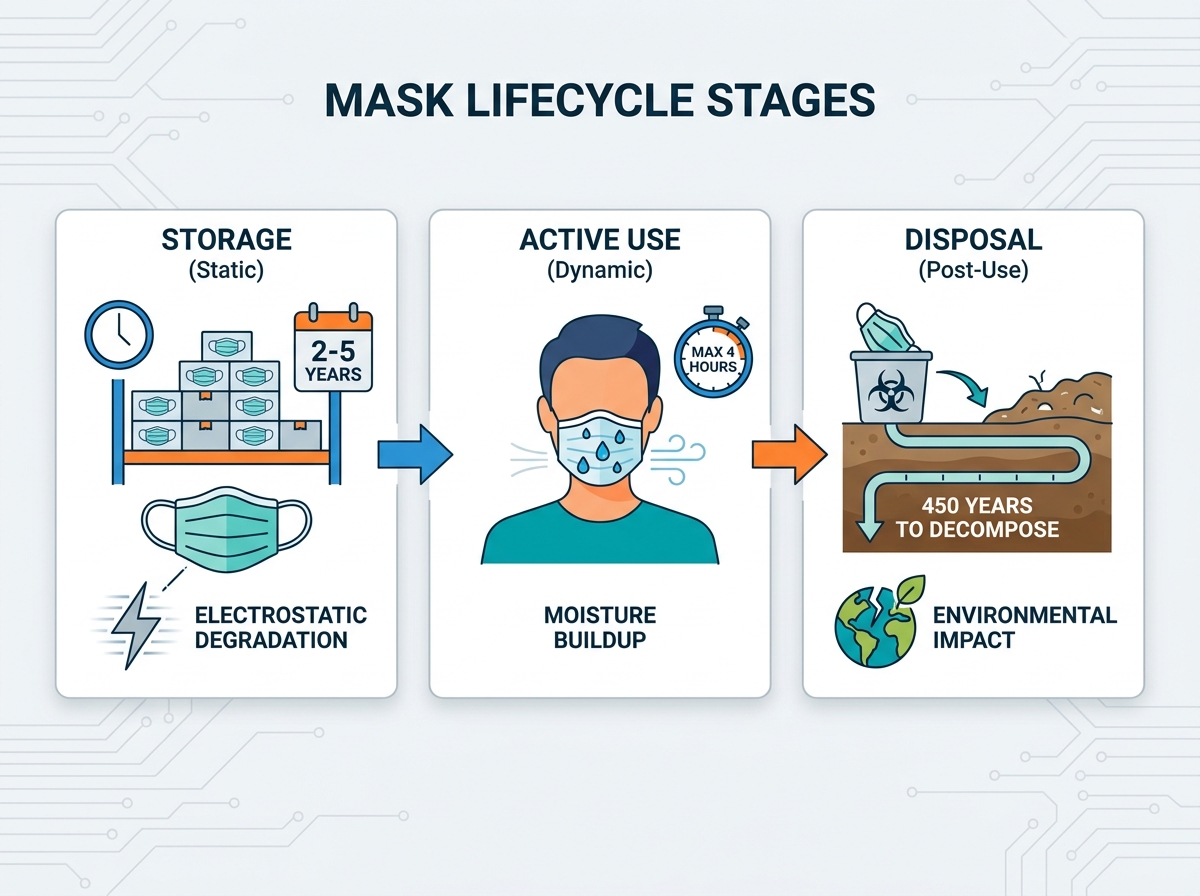
This guide breaks down the three critical phases of a mask’s lifecycle—storage (static), active use (dynamic), and disposal (post-use). You will discover how to evaluate each distinct phase effectively across your organization. We help purchasing managers make evidence-based decisions for superior protection and environmental sustainability.
Table of Contents
Static Lifespan: Most disposable masks expire 2 to 5 years from the manufacturing date due to the natural degradation of their electrostatic charge.
Dynamic Lifespan: Standard industry guidelines dictate a maximum active wear time of 4 hours before moisture buildup compromises filtration efficacy.
Contamination Variables: Visible soiling, fluid exposure, or increased breathing resistance immediately end a mask’s usable life, regardless of time worn.
Environmental Impact: Traditional polypropylene masks take up to 450 years to decompose, making end-of-life disposal and sustainable procurement key considerations for modern ESG (Environmental, Social, and Governance) goals.
Organizations often buy protective gear in massive bulk quantities. They frequently forget to track lot decay over time. This oversight creates a dangerous sense of false security among staff members. Using an expired mask exposes employees to airborne pathogens. It also exposes businesses to severe compliance liabilities. Regulatory bodies routinely penalize facilities for maintaining outdated safety equipment.
You must understand the underlying material science. A standard disposable mask relies on a specialized meltblown polymer filter layer. Manufacturers inject this layer using a permanent electrostatic charge. This invisible charge actively attracts and traps microscopic particles. Time gradually weakens this crucial magnetic-like effect.
Buyers must adopt a stricter evaluation lens during procurement. You cannot assess a supplier based solely on per-unit pricing. Smart purchasing requires evaluating actual material stability. You must demand clear batch labeling from all manufacturing partners. You should also verify their realistic durability claims against scientific evidence.
Supplier Evaluation Focus Areas
Evaluation Category | Standard Expectation | Red Flags to Avoid |
|---|---|---|
Material Stability | Proven meltblown charge retention | No technical data available |
Batch Labeling | Clear MFG and EXP printed dates | Blank boxes or missing lot codes |
Durability Claims | 2 to 5 year shelf life maximum | Claims of indefinite expiration |
Industry standards provide clear shelf life benchmarks for medical equipment. Medical and surgical masks typically maintain a two to five-year expiration window. The countdown begins on the exact manufacturing date. Leading health organizations globally recognize and enforce these standard timelines.
Material degradation happens invisibly on a molecular level. The primary failure involves the loss of internal static charge. A mask might look structurally perfect on the outside. However, a depleted electrostatic layer acts only as a physical sieve. This severely reduces the bacterial and particulate filtration efficiency.
Other physical components also break down over time. Elastic earloops undergo natural polymer degradation in storage. They become highly brittle and snap under minimal tension. The metal nose-wire often suffers from gradual oxidation. This rusting prevents the mask from forming a secure facial seal.
Poor storage environments prematurely destroy protective materials. Extreme heat destabilizes the fragile meltblown polymer fibers. High humidity introduces moisture into the sealed packaging. Direct sunlight and ultraviolet exposure rapidly break down synthetic plastics.
We highly recommend implementing climate-controlled storage parameters. This proactive approach maximizes your return on investment. Keep your bulk inventory in designated dry zones. Maintain temperatures between 15°C and 25°C constantly. Store all unused boxes away from direct windows or industrial heaters.
Clinical standards strictly define usage limits for a Disposable Face Mask. The industry universally enforces a four-hour maximum active wear time. Human breath contains significant amounts of natural moisture. Humidity inevitably builds up inside the protective layers during respiration. This heavy moisture eventually neutralizes the critical electrostatic charge. Breathing resistance also increases significantly as fibers swell.
Different work environments dictate different replacement protocols. You must tailor your policies to specific operational risks. Relying on time alone is rarely sufficient for absolute safety.
In high-risk or clinical settings, rules are absolute. Healthcare workers must replace masks after every single patient encounter. Fluid exposure demands immediate disposal and replacement. Dental and surgical uses require frequent changes due to splatter risks.
General industrial use follows slightly broader guidelines. However, you must replace the mask whenever it becomes damp. Visible soiling from dirt or dust mandates an instant swap. If breathing becomes difficult, the filter is likely clogged entirely.
Replacement Trigger Chart
Work Environment | Standard Rule | Immediate Failure Trigger |
|---|---|---|
Clinical / Surgical | Single patient use | Blood or bodily fluid splatter |
Industrial / Factory | Change every 4 hours | Heavy dust clogging or moisture |
Corporate / General | Change daily or half-daily | Broken earloop or dampness |
Many consumers habitually hang used masks on their rearview mirrors. Others fold them into pockets for days at a time. Scientific evidence strongly advises against these dangerous practices. The warm, damp environment inside a used mask breeds bacteria rapidly. Reusing them introduces severe risks of facial bacterial colonization. Handling a used mask also promotes dangerous cross-contamination to your hands.
Buyers need a reliable system for shortlisting potential vendors. You can confidently select high-quality disposable face mask suppliers using careful logic. Stop relying solely on aggressive sales pitches. Start demanding transparent documentation from every manufacturing partner.
Follow these essential procurement steps:
Request formal certification documents before discussing bulk pricing.
Audit the supplier's historical compliance records thoroughly.
Ask for physical samples to test structural integrity firsthand.
Verify their warehouse storage conditions for large inventory blocks.
You must know how to read commercial packaging correctly. Instruct your receiving team to inspect incoming shipments strictly. They must look for clear Manufacturing Dates on every box. Expiration Dates must accompany them legibly. Verifiable Lot Numbers are non-negotiable for future product recalls.
Regulatory compliance checks form the backbone of safe procurement. You must match the product to regional regulatory standards accurately. Hospitals require FDA clearance or specific ASTM performance levels. Australian buyers must look for TGA approval certificates. Always verify these claims directly through official government databases.
Look out for vital trustworthiness indicators during vendor negotiations. Warn your purchasing department against suppliers offering indefinite lifespan claims. No synthetic filter material lasts forever. You should immediately reject vendors lacking accessible technical data sheets. True professionals proudly share their laboratory testing results.
Organizations must address the environmental elephant in the room. Traditional single-use masks rely heavily on petroleum-based plastics. They are primarily made of polypropylene thermoplastic materials. Scientists estimate these items take up to 450 years to decompose. They eventually break down into harmful microplastics in our oceans.
Safe disposal protocols vary significantly across different sectors. You must establish strict waste management procedures.
Medical facilities must use designated red biohazard bags.
Clinics must incinerate contaminated masks following local health laws.
Corporate offices should utilize closed general waste bins.
Civilians must cut elastic earloops before discarding them safely.
Future-proofing your procurement strategy is now a business imperative. The global market offers emerging eco-friendly alternatives. Biodegradable or highly recyclable mask options are gaining incredible traction. Organizations can align their PPE purchasing directly with corporate sustainability targets. Transitioning to greener alternatives improves public relations and environmental health simultaneously.
Properly managing your protective equipment lifespan ensures long-term organizational safety. The lifecycle requires active attention across storage, daily wear, and ultimate disposal. Ignoring expiry dates or wear-time limits jeopardizes health and regulatory standing.
Take action today by auditing your current inventory stockpiles immediately. Quarantine and discard any expired lots sitting in your warehouse. Implement strict four-hour wear protocols for your entire staff. Finally, partner exclusively with transparent, compliance-focused suppliers moving forward.
A: No. Washing destroys the meltblown filter's electrostatic charge completely. Soap and water ruin the structural integrity of the delicate fibers. This process renders the equipment entirely ineffective against microscopic airborne pathogens.
A: Visual cues often indicate severe material degradation. Look for noticeable yellowing of the once-white inner fabric. Test the ear loops to see if they feel brittle or snap easily. A stale chemical odor also indicates age. When in doubt, discard it safely.
A: No. Two expired masks do not recreate the lost electrostatic charge. Stacking them only increases your breathing resistance significantly. This discomfort increases the likelihood of contaminated air leaking directly from the sides due to a poor fit.