Views: 0 Author: Site Editor Publish Time: 2026-07-21 Origin: Site


Industrial environments present severe respiratory hazards. Manufacturing plants, construction sites, and chemical processing facilities routinely generate dangerous airborne particulates. Standard commercial personal protective equipment simply cannot handle these aggressive environments safely. Procurement teams often struggle when navigating a highly fragmented market. They face catalogs saturated with mislabeled or counterfeit products making false claims. Selecting the wrong Disposable Face Mask risks serious OSHA compliance violations. It also decreases worker productivity due to respiratory fatigue and severely compromises personal safety. We created this guide to help you overcome these common procurement hurdles safely. You will receive a transparent, evidence-based breakdown of five critical safety specifications. These technical details remain essential for evaluating true industrial-grade respirators. Use this knowledge to shortlist reliable vendors and protect your workforce effectively.
Table of Contents
Filtration & Breathability are Interdependent: High Particulate Filtration Efficiency (PFE) must be balanced with low breathing resistance (Delta P) to ensure worker compliance during long shifts.
Fit Dictates Function: Specifications on paper are void without a proper seal; industrial applications require specific fastening mechanisms (e.g., dual headbands) over standard ear loops.
Compliance is Verifiable: Legitimate industrial masks carry traceable certification numbers (e.g., NIOSH TC numbers) that must be cross-referenced with official databases to mitigate counterfeit risks.
Material Durability Matters: Fluid and flame resistance (mapped to ASTM levels) are non-negotiable for environments with liquid hazards or sparks.
Differentiating between product tiers remains a massive business problem today. You cannot treat all facial coverings equally. Procurement teams often confuse medical surgical masks, community face coverings, and true industrial respirators. Medical masks prioritize source control. They protect the patient from the wearer. They fit loosely against the face. Community face coverings offer basic droplet blocking. They lack rigorous testing standards. True industrial respirators operate differently. Products like N95, FFP2, or FFP3 masks protect the wearer from the environment. They require a hermetic seal against the face. They undergo extreme filtration testing.
A successful procurement rollout requires balancing two critical factors. First, you must guarantee strict regulatory compliance. OSHA and NIOSH standards dictate baseline safety requirements. Second, you must ensure high end-user adoption. Workers will not wear uncomfortable gear. Comfort and durability dictate daily compliance. These two goals often conflict. Finding the sweet spot requires careful technical evaluation.
Supplying inadequate protective gear introduces massive implementation risk. Imagine supplying masks passing basic filtration specs. However, they fail standard fit-testing. Or perhaps they cause extreme thermal burden. Heat builds up rapidly. Workers feel suffocated. They pull the masks down below their noses. This completely ruins adherence. Poor mask adherence leads directly to respiratory exposure. Ultimately, this exposes your organization to severe legal liability and compromises team health.
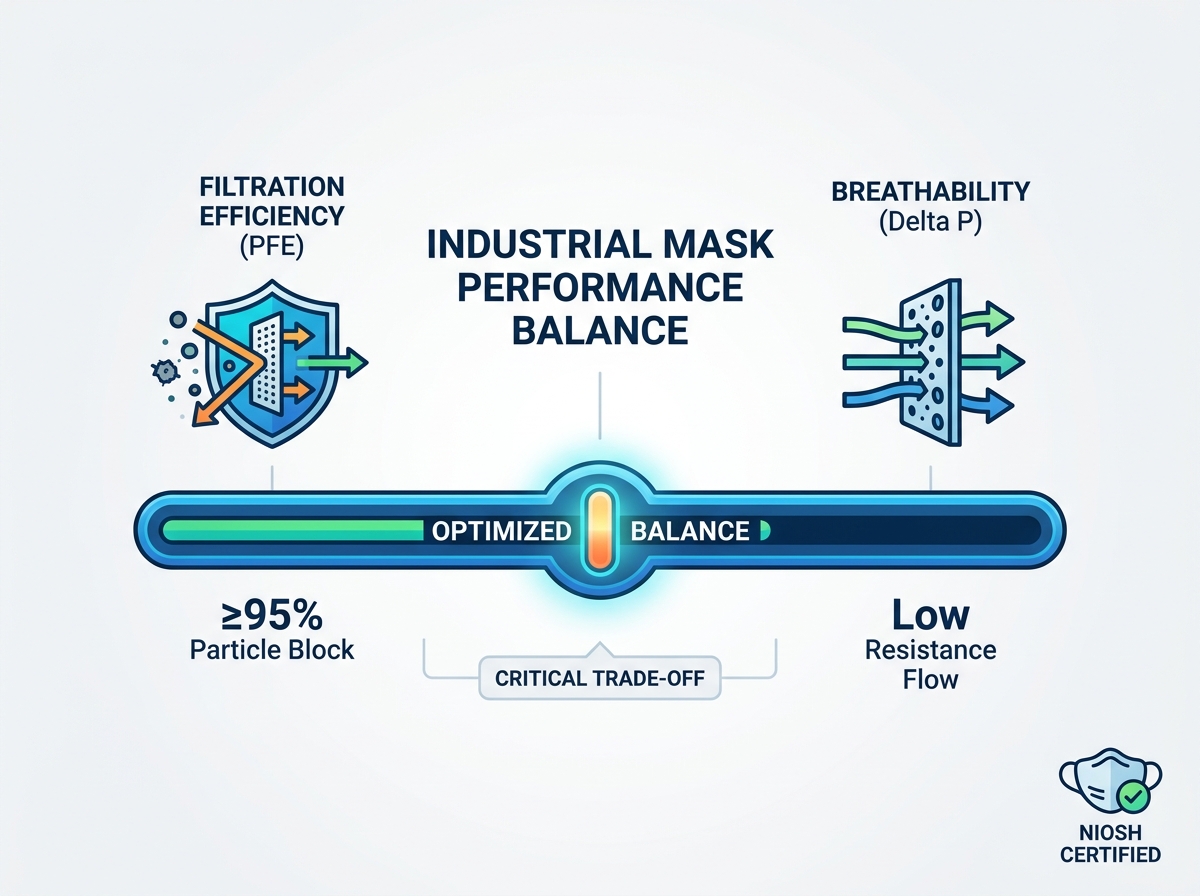
Particulate Filtration Efficiency acts as the core defensive metric. You must specify the exact percentage of airborne particles blocked. Standard industrial masks block either ≥95% or ≥99% of microscopic particulates. You must also evaluate the testing medium used during certification. This medium dictates real-world hazard compatibility.
Labs use NaCl (sodium chloride) to test for non-oil particulates. They use DOP (dioctyl phthalate) to test for oil-based particulates. You must align the test medium with your specific site hazards. Below is a simple comparison chart outlining these standard classifications.
Filter Classification | Testing Medium | Hazard Compatibility | Primary Industrial Application |
|---|---|---|---|
N-Series (e.g., N95) | NaCl | Non-oil particulates only | Dry manufacturing, construction, sanding |
R-Series (e.g., R95) | DOP | Oil-resistant (up to 8 hours) | Light machining, printing, petroleum facilities |
P-Series (e.g., P100) | DOP | Oil-proof (strongly resistant) | Heavy chemical processing, oil refineries |
Breathing resistance represents the second half of this equation. Engineers call this metric Delta P. It measures the pressure drop across the mask material. Lower resistance means better breathability. Industrial shifts run long. They involve heavy physical exertion. Workers require gear maintaining structural integrity without excessive thermal buildup. High inhalation resistance exhausts workers quickly. It leads to dangerous non-compliance.
You must acknowledge a harsh trade-off reality here. Highly dense filter media blocks more particles. However, it naturally restricts airflow. Be highly skeptical of vendors claiming maximum filtration with zero breathing resistance. Legitimate manufacturers achieve this balance using specialized filter media technologies. They utilize melt-blown fabrics holding electrostatic charges. This attracts particles magnetically without clogging air pathways. Always ask suppliers to explain their specific filtration technology when purchasing a Disposable Face Mask.
Specifications on paper mean absolutely nothing without a proper facial seal. Fastening mechanisms directly dictate seal integrity. Standard ear loops cannot provide the tension required for a tight seal. They pull weakly behind the ears. This leaves massive gaps along the cheeks and chin. Contaminated air follows the path of least resistance. It flows right through those gaps.
Industrial applications demand robust fastening features. Look for dual elastic headbands. One band rests high on the crown. The other rests securely at the base of the neck. This creates uniform pressure around the perimeter. Furthermore, adjustable nose clips remain mandatory. Look for memory-wire designs. They mold precisely across the nasal bridge. They hold their shape during heavy movement.
The chosen mask specification must support mandatory fit testing. OSHA Standard 1910.134 outlines this process clearly. Proper fit testing involves several key steps:
Medical Evaluation: Ensuring the worker can safely wear a respirator.
Sensitivity Test: Confirming the worker can taste the test solution (sweet or bitter).
Exercise Protocol: Having the worker perform specific movements (talking, bending, turning).
Pass/Fail Determination: Verifying the seal remains intact throughout all movements without leakage.
Material durability constitutes the fourth vital specification. Identify the outer-layer material composition immediately. Manufacturers commonly use spunbond polypropylene. It offers excellent structural rigidity and moisture repellence. Some environments present splashing fluids or flying sparks. In these cases, you must evaluate masks against ASTM F2100 standards.
ASTM F2100 measures fluid resistance in mm Hg. Level 1 provides basic resistance at 80 mm Hg. Level 3 provides maximum resistance at 160 mm Hg. Equivalently, check for industrial flammability tests. A stray spark hitting a highly flammable mask causes catastrophic facial burns. Ensure your selected vendor verifies these durability metrics through accredited testing bodies.
A high-quality protective garment must explicitly list its exact regulatory standards. Vague language indicates danger. You should expect specific alphanumeric codes printed on the packaging. American operations rely on NIOSH 42 CFR Part 84. European operations rely on EN 149:2001+A1:2009. These codes prove the product survived rigorous independent laboratory scrutiny.
Trust always requires verification. Counterfeit products flood the global supply chain constantly. You must require NIOSH Approval (TC) Numbers. Manufacturers must print these directly on the mask face. However, printed text is easily forged. You must cross-reference these claims actively. Input the provided TC number into the CDC/NIOSH Certified Equipment List (CEL). The database will confirm if the product holds active approval.
Procurement teams must train themselves to spot common red flags immediately. Identifying counterfeits saves lives. Watch out for these specific warning signs:
"FDA Registered" Claims: The FDA oversees medical devices. They do not oversee industrial respirators. Vendors using this as a primary selling point for industrial gear lack credibility.
Missing Model Numbers: Legitimate testing applies to specific models, not entire brands. If the packaging lacks a clear model number, avoid it.
Misspelled Certification Logos: Counterfeiters frequently alter logos slightly to avoid trademark lawsuits. Watch for subtle typos like "NOISH" instead of "NIOSH."
Decorative Add-ons: True industrial gear avoids sequins, fabric patterns, or external embellishments. These modifications destroy regulatory compliance instantly.
Knowing the specifications only solves half the problem. You must systematically evaluate the suppliers themselves. Establish a strict documentation request policy. Mandate Technical Data Sheets (TDS) upfront. Request independent third-party lab testing reports. Do this before signing any bulk orders. Reputable suppliers provide these documents willingly and quickly. Hesitation indicates hidden problems.
Never commit to annual procurement contracts blindly. Institute a trial and adoption pilot program first. Order a small batch of a selected Disposable Face Mask. Distribute them to a designated test group on the floor. Conduct on-site fit testing. Gather qualitative worker feedback. Ask them about comfort. Check if the elastic snaps easily. Determine if the fabric causes skin irritation. Worker buy-in during this pilot phase guarantees smoother facility-wide rollouts.
Finally, evaluate supply chain scalability. Global disruptions happen frequently. You need a partner capable of weathering storms. Evaluate vendor transparency regarding raw material sourcing. Ask where they get their melt-blown fabric. Request clear shelf-life guarantees. Ensure they rotate stock properly before shipping. Clarify their lead times during emergency scenarios. A great product means nothing if it sits on a cargo ship for six months while your facility shuts down.
Selecting protective respiratory gear for industrial applications demands intense scrutiny. It stands as a critical risk-management decision for any organization. Focusing on precise specifications prevents costly mistakes. You must verify Particulate Filtration Efficiency (PFE) alongside breathing resistance. You must demand robust seal integrity and extreme material durability. Above all, you must mandate verifiable certifications to block counterfeits.
To implement this knowledge, take the following steps today:
Audit your current PPE inventory against these five specific criteria.
Discard any non-compliant or expired respirators immediately.
Request updated compliance documentation from all existing vendors.
Establish a strict trial protocol for any prospective suppliers entering your facility.
A: The primary differences lie in fit and filtration direction. Surgical masks protect the surrounding environment from the wearer. They offer loose fits and prioritize source control. Conversely, industrial masks act as true respirators. They protect the wearer from dangerous airborne hazards. They achieve this via a tight, hermetic facial seal.
A: Generally, no. Ear loops rarely provide the necessary tension required for industrial safety. They fail to pull the fabric flush against the skin. Therefore, they almost always fail mandatory OSHA fit testing for respiratory protection. Industrial environments require dual elastic headbands instead.
A: Look for missing TC approval numbers. Watch for a lack of NIOSH markings in block letters. Beware of decorative add-ons or claims of approval for children. Always verify the provided approval numbers against the CDC's official Certified Equipment List database.
A: The typical shelf life ranges from 3 to 5 years from the date of manufacture. However, you must store them correctly. Keep them in climate-controlled areas away from direct sunlight and harsh chemicals. Always check the manufacturer's specific expiration dates to avoid utilizing degraded elastic bands or compromised filter media.