Views: 0 Author: Site Editor Publish Time: 2026-07-21 Origin: Site


Procurement and safety managers face a constant tension. You must balance employee comfort, strict compliance standards, and bulk-purchasing budgets. Selecting the right protective gear is no longer a reactive measure. It serves as a standard operational requirement. This choice directly impacts daily productivity and corporate liability. Making an uninformed choice creates significant health risks. It also frustrates employees who wear this equipment for long hours. We designed this guide to help you navigate these exact challenges. It provides an evidence-based framework for evaluating, shortlisting, and sourcing equipment for enterprise environments. You will learn how to match specific hazard profiles to the correct protective tiers. We will explore key dimensions like breathability, fit, and hypoallergenic materials. By following these steps, you can confidently source a high-quality Disposable Face Mask that meets your exact workplace needs.
Table of Contents
Compliance dictates baseline requirements: Match the mask's rating (e.g., ASTM Level 1-3, N95) directly to your workplace's specific hazard profile (fluid exposure, particulate matter, general hygiene).
Comfort drives adoption: High-filtration masks fail if poor breathability or skin irritation causes employees to wear them incorrectly.
Sourcing requires skepticism: Vet suppliers for verifiable certifications (FDA, NIOSH) and consistent supply chain stability to avoid counterfeit risks and stockouts.
Industry context matters: Foodservice, clinical, and corporate environments require distinct features, from moisture resistance in humid kitchens to aesthetic consistency in client-facing roles.
Over-specifying personal protective equipment wastes valuable resources. You end up acquiring clinical-grade respirators for low-risk office environments. Conversely, under-specifying leaves your workforce vulnerable. It creates severe regulatory liabilities. You must establish a clear risk profile before evaluating any suppliers. This approach aligns your safety protocols directly with daily operational realities.
You need to identify the primary risk factors present in your facilities. Workplaces encounter different hazard types. Some environments face biological aerosols. Others deal with high-velocity fluid splashes. Many industrial sites manage heavy dust and particulates. General corporate offices usually only require basic source control. You should reference OSHA general duty clauses alongside industry-specific mandates. These regulations form the foundation of your purchasing decision.
Common Mistakes:
Treating all workplace zones equally instead of mapping risks by specific departments.
Ignoring ventilation metrics when assessing airborne transmission risks.
Failing to document your hazard assessment, which complicates OSHA compliance audits.
Understanding equipment tiers prevents dangerous mismatching. Each tier serves a highly specific function. You must deploy them according to environmental demands.
Standard 3-Ply: These work best for general office settings, retail spaces, and low-risk environments. They provide excellent source control. They capture large droplets expelled by the wearer.
ASTM-Rated Surgical Masks: These are mandatory for clinical, dental, and fluid-risk environments. They feature tested fluid resistance. They protect the wearer from external splashes.
Respirators (N95/KN95): High-risk airborne environments require these units. They seal tightly to the face. You must implement formal fit-testing programs to use them legally and effectively.
Protective Tier Matrix
Mask Tier | Primary Function | Ideal Environment | Fit Requirement |
|---|---|---|---|
Standard 3-Ply | Source control, basic hygiene | Offices, retail, lobbies | Loose fitting |
ASTM-Rated (Level 1-3) | Fluid resistance, bacterial filtration | Clinics, labs, triage | Loose fitting with gap reduction |
Respirators (N95) | Airborne particulate filtration | Isolation wards, heavy industry | Tight seal, mandatory fit test |
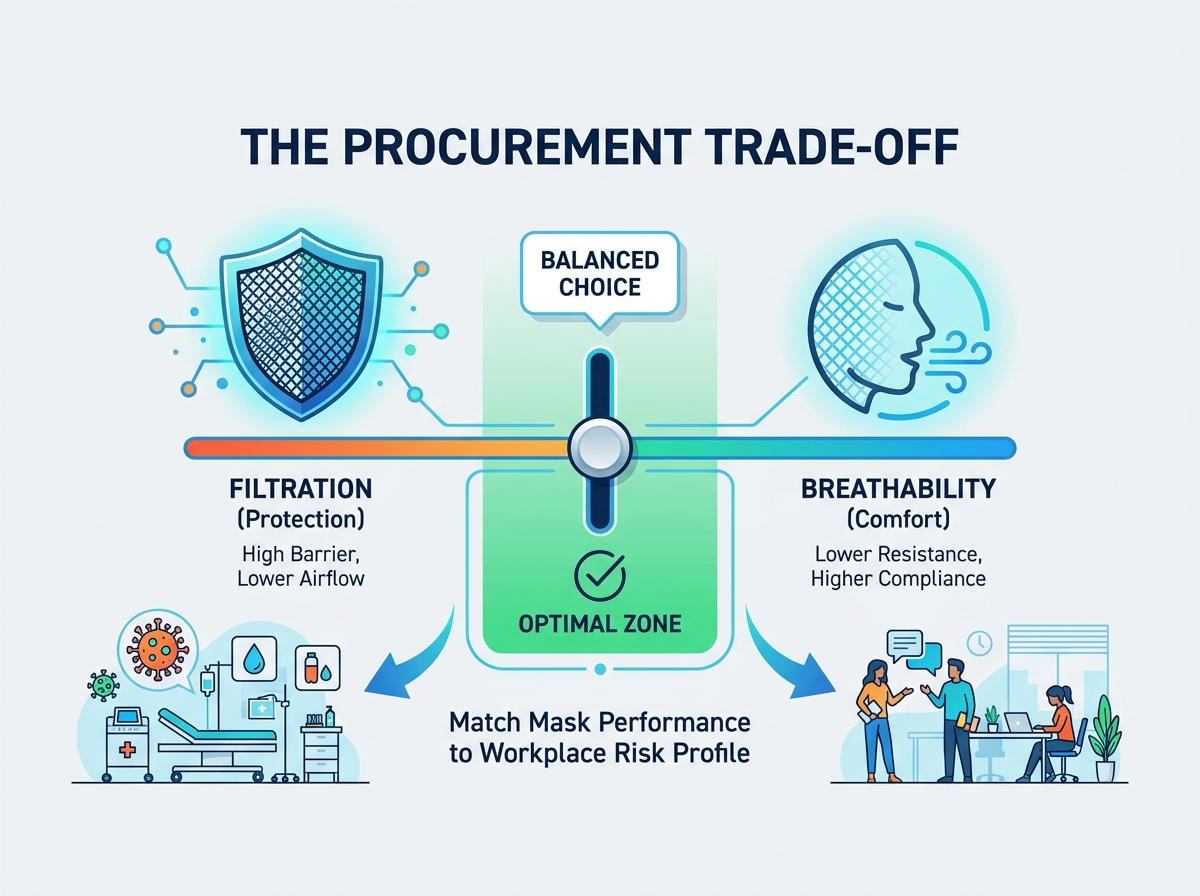
You need a features-to-outcomes framework. Moving beyond basic specifications helps you understand actual workplace impact. Mask construction directly dictates daily business operations. Evaluating physical characteristics ensures your teams remain compliant and comfortable.
A fundamental trade-off exists in protective gear design. Higher filtration usually creates higher breathing resistance. Manufacturers measure this resistance as pressure drop (Delta P). Dense materials block tiny particles effectively. However, they make inhaling much harder.
Implementation reality often conflicts with laboratory testing. If breathability feels poor, employees will lower the gear below their noses. This action defeats the entire safety protocol. You should prioritize advanced melt-blown layers. These specialized layers balance high Bacterial Filtration Efficiency (BFE) with low breathing resistance. Employees stay protected without feeling suffocated during long shifts.
Filtration Efficiency and Breathability Chart
Material Type | Filtration (BFE) | Breathability (Delta P) | Employee Compliance Likelihood |
|---|---|---|---|
Basic Spunbond | Low (<80%) | Excellent (<2.0) | High |
Standard Melt-Blown | High (>95%) | Moderate (3.0 - 4.0) | Medium |
Advanced Electrostatic | Very High (>98%) | Good (<3.0) | High |
Physical hardware dictates long-term wearability. You must evaluate ear loop elasticity and material composition. Flat ear loops distribute pressure evenly across the skin. Round loops often dig into the cartilage after several hours. Selecting the right loop style prevents headaches and physical fatigue.
Nose bridges play a critical role in safety. You need malleable, metal-core nose strips. Plastic strips rarely hold their shape. A weak seal pushes warm breath upward. This fogs up safety glasses instantly. Fogged eyewear creates a severe hazard in industrial and laboratory settings. A secure nose wire anchors the Disposable Face Mask firmly in place.
Skin irritation severely damages employee morale. Contact dermatitis leads to lost productivity and increased complaints. Cheap materials often contain harsh dyes or chemical residues. These residues react poorly with human skin over an eight-hour shift.
You must specify hypoallergenic inner layers. Ensure the materials are explicitly latex-free. You also need to verify they remain fiberglass-free. Soft, non-woven inner fabrics absorb facial moisture without causing friction. Prioritizing skin health dramatically improves daily protocol adherence.
Generic purchasing strategies rarely succeed. Different sectors demand unique physical properties. You must match the equipment features to the specific environmental stressors your teams face every day.
Clinical environments require strict adherence to the ASTM F2100 standard. This framework measures fluid resistance, breathability, and flammability. You cannot compromise on these metrics in medical settings.
You must break down requirements by level. Level 1 offers low fluid resistance. It works well for standard patient exams and visitor triage. Level 3 provides high fluid resistance. You need Level 3 for trauma centers, surgical suites, and heavy fluid-risk zones. Over-deploying Level 3 gear exhausts supplies quickly. Segment your clinical purchases based on exact departmental risks.
Kitchens present hostile environments for protective gear. Employees endure high heat and extreme humidity. Steam from cooking equipment degrades basic materials rapidly. Sweat accumulates quickly during busy meal services.
Your primary decision criteria must focus on structural integrity. You need gear that does not collapse into the mouth when damp. Structural folds must maintain a breathing chamber even when saturated. Moisture-resistant outer layers help deflect ambient steam. Consider supplying multiple units per shift for back-of-house staff to ensure hygiene.
Client interactions require a different set of priorities. Aesthetic consistency matters in corporate environments. You might consider brand uniformity. Black, blue, or custom-colored options help maintain a professional appearance. They blend seamlessly with corporate uniforms.
Vocal clarity is another critical factor. Thick materials muffle voices. This frustrates customers and exhausts employees who must shout to be heard. You should evaluate acoustic transmission. A well-structured Disposable Face Mask allows clear articulation during customer service interactions.
Evaluating the vendor is just as important as evaluating the product. You need criteria for shortlisting B2B distributors or direct manufacturers. A reliable partner ensures you never face sudden stockouts or compliance failures.
You must demand verifiable testing data. Request third-party lab results from reputable institutions like Nelson Labs. Cross-reference FDA registration numbers directly on the official government database. Legitimate suppliers provide this documentation immediately.
Watch out for common red flags. Many vendors make vague claims like "FDA Approved" for standard 3-ply units. The FDA clears or registers these items. It does not "approve" them in the colloquial sense. Misleading marketing language often indicates a lack of regulatory understanding. Always trust independent lab reports over promotional brochures.
Best Practices for Certification Checks:
Request the full, unredacted lab report from the manufacturer.
Check the date on the lab report to ensure recent testing.
Verify the manufacturer name on the product matches the name on the FDA registry.
You must look beyond the initial transaction. Factor in bulk-shipping reliability. A vendor might struggle to fulfill massive enterprise orders on time. Delays halt your operations. Assess their logistical infrastructure before signing long-term contracts.
Evaluate Minimum Order Quantities (MOQs). Some suppliers demand massive MOQs that clog your storage facilities. Others offer flexible recurring shipments. You must also account for shelf-life. Most disposable items expire after two to three years. Material degradation occurs over time. Elastic bands become brittle. Electrostatic charges in filter layers dissipate. Do not stockpile more than you can consume within the viable shelf-life.
Testing prevents costly mistakes. We strongly advise against buying a 10,000-unit pallet blind. Theoretical specifications do not always translate to practical comfort. You need physical proof before committing to a massive purchase order.
A pilot program provides invaluable real-world data. It empowers your employees and builds consensus around the final decision. Testing distinct options side-by-side reveals hidden flaws. It highlights differences in ear loop tension, fabric softness, and breathability.
Follow this structured process to finalize your procurement decision:
Request Samples: Contact two or three fully vetted suppliers. Ask for sample packs representing their different tiers.
Conduct a Wear Test: Distribute the samples to a small subset of employees. Ensure you include staff from different departments and physical environments. Run the test for three consecutive days.
Gather Standardized Feedback: Create a simple survey. Ask users to rate ear loop comfort, breathing ease, and structural durability.
Evaluate Results: Tabulate the feedback. Eliminate any option that causes skin irritation or fogged glasses.
Issue the Purchase Order: Select the highest-rated option. Establish an initial delivery schedule with your chosen vendor.
Choosing the best protective equipment requires a balanced approach. You must align strict regulatory compliance with actual employee wearability. Ignoring comfort leads to improper usage. Ignoring compliance leads to severe liability. By thoroughly assessing your workplace risks, you set a clear baseline for performance. Evaluating fit, breathability, and material safety ensures your team remains protected and productive.
Always demand transparent testing data from your suppliers. Implement a pilot program to validate your choices before committing to large volumes. Ready to upgrade your workplace safety protocols? Contact our sales team today. We can provide compliance documentation, discuss volume fulfillment, or send a free sample kit tailored specifically to your industry needs.
A: ASTM Level 1 units undergo rigorous laboratory testing for fluid resistance, bacterial filtration efficiency, and flammability. They are certified for medical environments. Standard 3-ply civilian versions lack regulated testing for fluid resistance. They serve primarily as general source control for low-risk settings, blocking large expelled droplets but not protecting against high-velocity fluids.
A: Employees should replace them every four hours during a standard shift. However, they must change them immediately if the material becomes damp from breath, sweat, or external moisture. Damp materials lose filtration efficiency and structural integrity. Strict hygiene protocols dictate immediate replacement if the surface becomes visibly soiled or damaged.
A: No. These products typically have a shelf-life of two to three years. Over time, materials degrade significantly. Elastic ear loops become brittle and snap. The electrostatic charge in the melt-blown filtration layer dissipates, reducing its ability to trap airborne particles. Always check manufacturer expiration dates and rotate your stock regularly.
A: You must verify the manufacturer's documentation independently. Request third-party testing reports from recognized facilities like Nelson Labs. Cross-reference the company's registration number directly on the official FDA database. Avoid purchasing from unverified third-party marketplace sellers. Always source directly from established B2B distributors or reputable manufacturers with transparent supply chains.