Views: 0 Author: Site Editor Publish Time: 2026-07-21 Origin: Site


Parents and school administrators face a recurring challenge today. They must balance reliable respiratory protection against a child's comfort. Kids often resist wearing protective gear. This reality makes a child's willingness to wear the item just as crucial as its safety rating.
You will quickly notice how difficult evaluating marketing claims can be. Many brands promise high protection. However, they frequently fail to meet verifiable safety standards. Finding a genuine Disposable Face Mask designed specifically for pediatric use requires careful scrutiny. Poorly made products offer a false sense of security.
This guide serves as your comprehensive decision framework. We will help you evaluate filtration metrics. You will learn how to ensure a proper fit. We also explain how to verify regulatory compliance. You can then make an informed, confident purchase for the children in your care.
Table of Contents
Filtration efficacy is irrelevant if the mask does not fit a child's face securely; fit and material quality must be evaluated together.
Not all "3-ply" masks meet standard testing criteria; buyers must look for verifiable compliance (e.g., ASTM standards or recognized equivalents).
Comfort features (adjustable nose wires, ultra-soft ear loops) are critical for continuous wear and reducing "mask-fidgeting" risks.
Proper sizing varies significantly by age and facial structure; pilot testing a small batch is recommended before bulk purchasing.
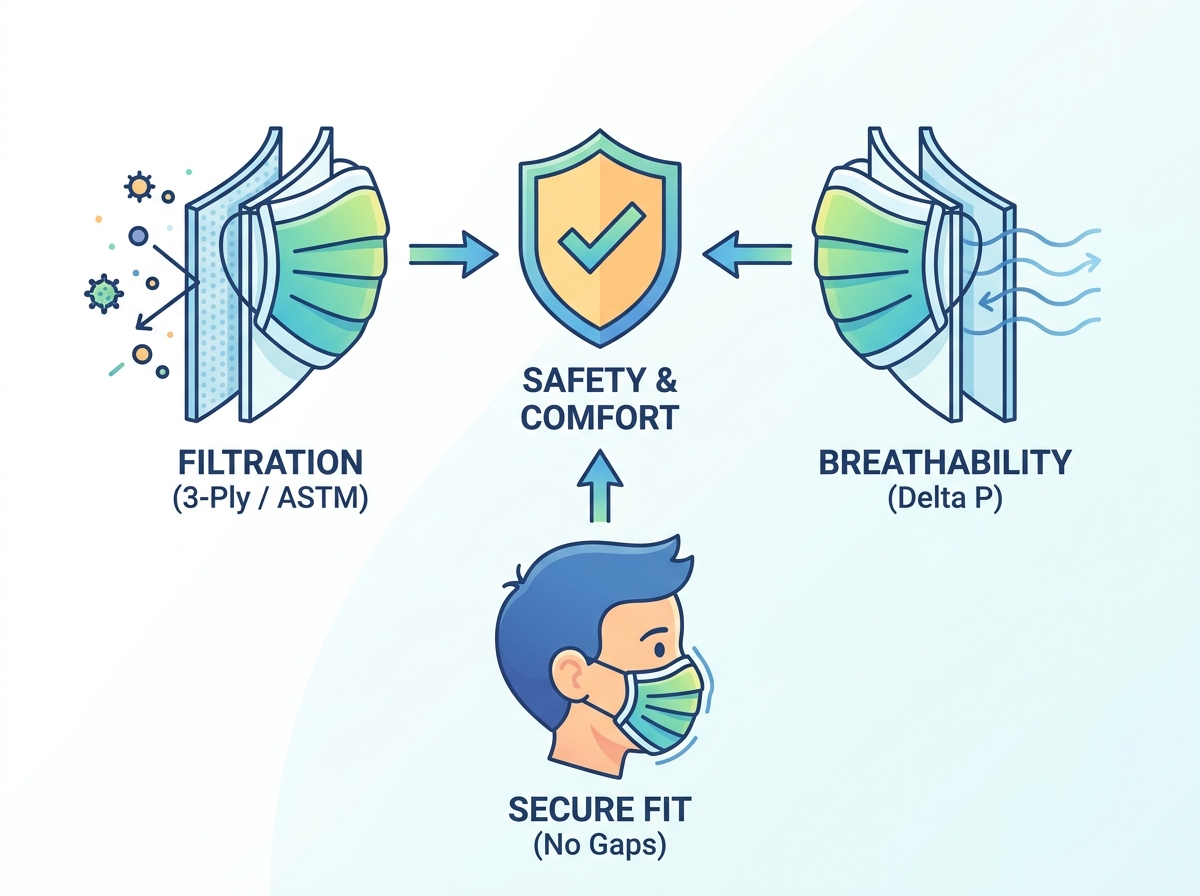
Respiratory safety relies on a mandatory balance between filtration, breathability, and fit. Industry experts call this the safety triad. A failure in one area negates the others entirely. High filtration materials mean nothing if poor fit creates massive gaps. We must evaluate all three elements simultaneously.
Filtration dictates how many particles the material blocks. Breathability determines how easily air passes through that material. Fit ensures inhaled and exhaled air actually travels through the filter. If you buy a highly rigid Disposable Face Mask, children will struggle to breathe. They will likely pull it below their noses. A perfect seal requires soft, pliable materials. You must prioritize this delicate balance.
Standard 3-ply models typically filter larger respiratory droplets. These droplets occur when people cough or sneeze. Medical-grade versions, however, undergo rigorous testing. They capture much smaller airborne aerosols. Everyday non-medical coverings differ significantly from tested products. You should look for ASTM F2100 testing standards.
Level 1: Suitable for general everyday use and low-risk environments.
Level 2: Offers moderate fluid resistance and better particulate filtration.
Level 3: Provides maximum fluid resistance for high-risk medical settings.
Standardized testing guarantees the middle melt-blown layer functions correctly. It uses an electrostatic charge to trap microscopic particles.
Manufacturers measure breathability using differential pressure. We call this metric Delta P. It measures air resistance across the mask material. High filtration often restricts airflow. If breathability drops too low, air finds the path of least resistance. It escapes through the sides or top edges.
Active kids run, play, and breathe heavily. A low-breathability product forces unfiltered air out the cheeks. This renders the protective gear completely ineffective. You want a Delta P score indicating easy airflow. Good breathability keeps children cool. It prevents the internal moisture buildup causing skin irritation.
Selecting the right product requires understanding the available design categories. You will generally find two main options on the market. Each serves different environments and risk levels.
These traditional pleated models dominate store shelves. They feature three distinct layers. The outer layer repels moisture. The middle layer filters particles. The inner layer absorbs sweat. They work well for daily school routines.
Pros: They are highly cost-effective. They offer excellent breathability. Kids find them lightweight and unobtrusive in low-risk environments.
Cons: They often lack a tight facial seal. Gaps frequently appear near the cheeks. Manufacturing quality varies wildly between unverified brands.
These products mimic occupational respirators. You usually see them labeled as KN95 or KF94 styles. They feature advanced shapes. Bifold designs fold flat down the middle. Boat-shape (KF94) designs feature a distinct central panel. Both shapes improve facial sealing.
Pros: They provide a tighter seal. The structured design keeps material away from the mouth. This increases comfort during extended wear. It also prevents the fabric from sucking inward during heavy breathing.
Cons: They carry a higher cost per unit. Be aware of marketing terminology. "N95" is strictly an adult occupational standard. The National Institute for Occupational Safety and Health (NIOSH) does not test or certify pediatric sizes. Therefore, "Kids N95s" are technically unregulated marketing terms. Rely on KF94 models or reputable KN95 manufacturers instead.
Match the design type to the specific environment. Standard pleated versions work beautifully for general school use. They handle brief outdoor interactions well. High-filtration options suit crowded indoor spaces better. Use them during holiday travel. Use them during peak flu seasons. Keep both types available at home.
Mask Design | Ideal Environment | Breathability | Fit Profile |
|---|---|---|---|
Standard 3-Ply | Classrooms, playgrounds, low-risk areas | High | Loose to moderate seal |
Bifold KN95 Style | Travel, crowded indoor events | Moderate | Tight seal around cheeks |
Boat-Shape KF94 Style | Medical waiting rooms, long flights | Moderate | Excellent structural clearance |
The market unfortunately contains many counterfeit respiratory products. Falsified safety claims put children at risk. You must learn how to vet vendor claims effectively. A skeptical buyer makes safer choices.
Start by scrutinizing the packaging text. Discard products promising "100% virus protection." No fabric can guarantee absolute immunity. You should also watch out for unauthorized FDA logos. The FDA does not permit manufacturers to print its logo on commercial packaging. A prominent FDA logo usually indicates a counterfeit item.
Look for grammatical errors on the box. Legitimate medical suppliers employ strict quality control for packaging. Typos or strangely worded instructions serve as immediate red flags.
Transparency builds trustworthiness. Look for clear, comprehensive packaging details. Legitimate brands print their exact manufacturer name. They provide a physical street address. You should easily locate a lot number. Expiration dates must appear clearly. If a box lacks this basic tracing information, do not buy it.
You can perform simple tests at home. These tests verify the basic material integrity of a Disposable Face Mask. Always sacrifice one unit from a new batch for testing.
The Water Test: Form the item into a small cup shape. Pour a tablespoon of water onto the outer layer. The material should repel the liquid. Moisture should not seep through to the inside. True surgical materials feature strong hydrophobic properties.
The Cut Test: Take scissors and cut the edge open. Separate the layers. You must find exactly three distinct layers. The middle layer represents the melt-blown filter. It should look like delicate, spun sugar or fine tissue. It should not look like standard paper.
The Flame Test: Hold a lighter to the extracted middle layer. (Adults only). Genuine melt-blown fabric melts and disintegrates. It does not catch fire and burn like normal paper.
Children do not possess scaled-down adult faces. Their facial geometry differs fundamentally. Understanding these differences solves the most common safety failures.
Pediatric faces feature flatter nasal bridges. Their jawlines remain softer and less defined. Plump cheeks alter how fabric drapes. If you simply downsize an adult pattern, you create massive gaps. Air leaks heavily around the nose. It escapes widely under the chin. A downsized adult product remains completely ineffective for a five-year-old.
Specific hardware components define a successful fit. You must examine these parts closely.
Nose Wires: They must be highly moldable. They must retain their pinched shape perfectly. Look for metal cores or strong plastic cores. Flimsy wires just bounce back to a straight line. This allows the fabric to slip down the nose constantly.
Ear Loops vs. Headbands: You must evaluate elasticity and skin tension. Ear loops pull gently behind the ears. They are significantly easier for children to manage independently. Headbands stretch around the back of the head. Headbands offer a superior, tighter seal. However, young kids struggle to put them on without adult help.
Manufacturers generally divide pediatric products into three age brackets. You should map these brackets to your child's specific facial structure.
Toddler and Preschool (Ages 2-4): Look for extra-small dimensions. These typically measure around 12.5cm in width. They require highly elastic loops to accommodate rapid growth.
Elementary (Ages 5-8): This bracket needs wider coverage. Measurements often sit around 14.5cm. The nose wire requires extra stiffness to bridge developing nasal bones.
Pre-teen (Ages 9-12): They often need "small adult" sizes. Standard kids' sizes pull painfully on their ears. Adult sizes still gap at the cheeks. Look for specific youth transitional sizes.
Even the safest product fails if a child refuses to wear it. Physical comfort drives compliance. You must minimize sensory friction immediately.
Prolonged wear introduces the risk of contact dermatitis. Synthetic materials trap sweat against the skin. Chemical residues from manufacturing can trigger painful rashes. We strongly recommend finding hypoallergenic inner layers. The inner fabric should feel as soft as a premium facial tissue.
Always smell the product out of the box. Avoid products emitting distinct chemical or plastic odors. Strong smells indicate poor manufacturing practices. They will undoubtedly cause nausea or headaches during a long school day. Let new items air out for twenty minutes before use.
Establish realistic expectations for endurance. Young kids rarely tolerate continuous wear beyond two hours. You must plan for frequent breaks. Allow them to remove the covering safely outdoors.
Moisture destroys filtration efficiency. Breath and sweat accumulate rapidly. You must replace the item immediately if it becomes noticeably damp. Pack at least three spare units in a clean plastic bag for school days. Instruct educators to prompt changes after recess or gym class.
Adults must normalize the routine without displaying anxiety. Children mirror adult emotions perfectly. If you treat the protocol as a stressful burden, they will resist it. Frame it as a simple daily habit, like tying shoes or washing hands.
Teach proper handling techniques early. Ensure the child knows how to don and doff the item correctly. They must use only the ear loops. Instruct them never to touch the potentially contaminated front panel. Practice this routine in front of a mirror. Make it an empowering, independent skill.
Providing safe respiratory protection for kids demands careful attention to detail. The best protective covering is the one that fits well. It must meet basic, verifiable filtration standards. Most importantly, the child must actually wear it without constant fuss or adjustment. Balancing comfort and safety ensures genuine protection throughout the day.
Decision-makers should avoid rushing into massive bulk orders. We advise purchasing small sample packs from two or three reputable brands first. Test these samples for fit, durability, and comfort in real-world conditions. Once you verify a specific brand works for your child's unique facial structure, you can safely commit to larger subscription orders.
A: Pediatric health guidelines state it is unsafe for children under two years old to wear them. Infants and toddlers face severe suffocation risks. Their smaller airways cannot handle breathing resistance. Always consult your pediatrician if your older child has underlying respiratory conditions like severe asthma before implementing daily wear.
A: No. You must never wash them. Moisture instantly destroys the electrostatic charge embedded in the melt-blown filter layer. Washing degrades the delicate paper-like fibers, creating microscopic tears. Once damp from breath, sweat, or washing, the item loses all protective capabilities and must go in the trash.
A: Visual cues reveal fit issues instantly. Loose fits create noticeable gapping at the cheeks or chin. If your child wears glasses and they fog up constantly, air is escaping the top seal. Too tight fits leave deep, red indentations behind the ears or across the nasal bridge.
A: Regulatory nuance makes this tricky. N95 is strictly an adult occupational standard regulated by NIOSH. They do not test or certify pediatric sizes. Therefore, "Kids N95" is a marketing term. However, legitimate KN95 or KF94 equivalents do exist. These provide similar high-filtration materials cut specifically for smaller pediatric faces.