Views: 0 Author: Site Editor Publish Time: 2026-07-21 Origin: Site


The market for personal protective equipment remains incredibly saturated today. Buyers frequently feel overwhelmed by varying global standards. They face widespread counterfeit products and conflicting comfort claims from competing brands. The lasting impact of global health crises has made respiratory protection a permanent fixture in many industries. Choosing the right Disposable Face Mask requires careful, informed balancing. You must weigh filtration efficiency, breathability, and secure fit against long-term unit costs. You cannot rely on guesswork. Airborne risks vary significantly between daily environments, ranging from crowded transit hubs to sterile clinical wards. This article provides a clear, evidence-based comparison framework. Our goal helps individuals and procurement teams choose the exact mask profile. We map these options directly to your specific risk environment. By reading this comprehensive guide, you will learn how to evaluate core performance metrics. You will decode complex regulatory ratings and spot counterfeits before purchasing.
Table of Contents
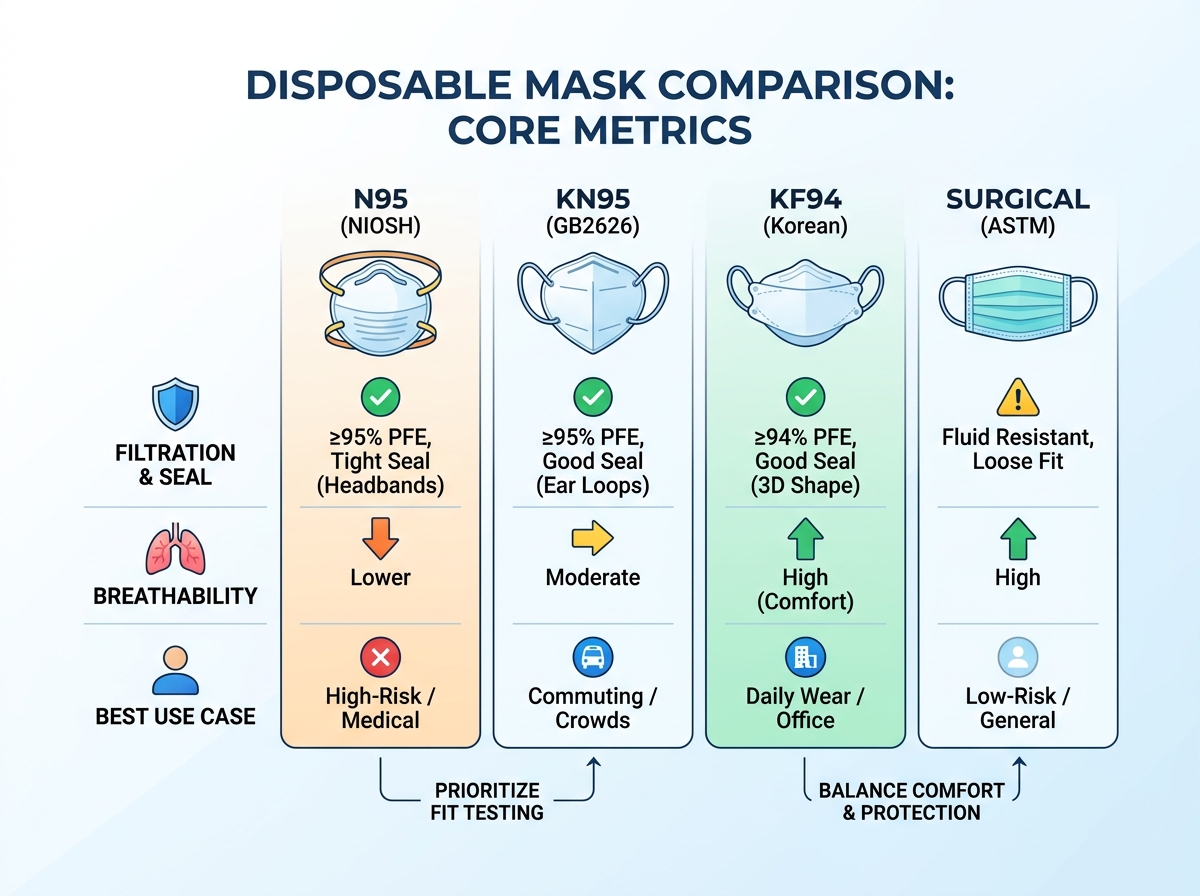
Highest Protection: N95 respirators offer the best seal and filtration (≥95%) but sacrifice extended-wear comfort due to tight headbands.
Balanced Daily Wear: KF94 (boat shape) and KN95 (bifold) masks provide high filtration with ear loops, making them ideal for commuting and travel, provided they are verified authentic.
Basic/Fluid Protection: ASTM-rated surgical masks are best for low-risk, general environments and preventing fluid transfer, but lack a tight seal against airborne particles.
Fit Over Material: A mask with 99% filtration material is ineffective if gaps exist at the cheeks or nose bridge; prioritized fit testing is essential.
Buyers often look solely at filtration percentages printed on the box. This flawed approach ignores how a mask actually functions during dynamic human movement. You must evaluate four core metrics to ensure real-world protection.
Filtration efficiency measures how effectively materials block hazardous particles. Industry experts divide this into two main testing categories. Particulate Filtration Efficiency (PFE) evaluates the blocking of dry, airborne aerosols. Laboratories typically test this using sodium chloride particles. These microscopic particles often measure under 0.3 microns. Bacterial Filtration Efficiency (BFE) focuses on larger expelled wet droplets. These droplets typically carry bacteria and measure around 3.0 microns. High PFE indicates robust protection against fine, suspended airborne hazards. High BFE simply means the material stops larger spits and coughs.
Breathability directly impacts long-term wearer compliance. Experts measure this as "pressure drop" across the filter media. They calculate how hard your lungs must work to pull air through the fabric. Higher filtration typically creates higher breathing resistance. Wearers often abandon restrictive devices due to headaches or physical discomfort. Specialized electrostatically charged melt-blown fabrics solve this critical issue. They attract and trap tiny particles magnetically. This innovation allows wider fabric pores and much easier breathing without sacrificing safety.
A strong filter fails completely if inhaled air bypasses it. We must distinguish between "source control" and "personal protection." Source control uses a loose fit to protect other people in the room. It catches large droplets expelled by the wearer. Personal protection requires an uninterrupted, tight seal against the face. This tight seal forces all inhaled air directly through the protective filter media. It protects the wearer from external airborne hazards circulating in the environment.
Different countries use unique testing frameworks for protective gear. Understanding these global benchmarks prevents dangerous procurement mistakes. The comparative table below outlines the primary regulatory landscapes governing respiratory safety.
Standard / Region | Regulating Body | Primary Focus |
|---|---|---|
N95 (United States) | NIOSH | ≥95% PFE, strict headband fit, no ear loops allowed |
KN95 (China) | GB2626-2019 | ≥95% PFE, typically utilizes an ear loop design |
KF94 (South Korea) | KMOEL | ≥94% PFE, unique 3D boat shape for breathability |
Type IIR (Europe) | EN 14683 | High BFE and strong fluid splash resistance |
Respirators offer the absolute highest level of personal respiratory protection available. They utilize advanced synthetic materials to filter out sub-micron particles effectively. Let us break down the three most popular global standards.
The United States National Institute for Occupational Safety and Health strictly regulates N95s. These devices represent the global gold standard for personal respiratory protection.
Specs: They guarantee ≥95% PFE against non-oil aerosols. They require strict formal fit-testing protocols in workplaces. NIOSH mandates dual headband designs to ensure exceptionally tight facial seals.
Best for: These excel in dangerous, high-risk environments. Medical settings treating infectious diseases demand them. Industrial dust exposure zones also require this level of unyielding protection.
Drawbacks: They feel quite uncomfortable during prolonged casual wear. The intense headband tension causes pressure sores. The dual straps make them difficult to don and doff quickly.
The KN95 follows China's rigorous respiratory protection standards for particulate filtering. It offers a more consumer-friendly design profile for the general public.
Specs: They provide ≥95% PFE against airborne particles. They typically feature elastic ear loops and a bifold tent design.
Best for: They suit daily commuting and commercial airline flights perfectly. They work exceedingly well in crowded indoor spaces like shopping malls.
Drawbacks: Buyers face a very high counterfeit risk on online marketplaces. Additionally, ear loops provide a substantially weaker facial seal than tensioned headbands.
South Korea developed the KF94 standard specifically for public health crises and yellow dust storms. It prioritizes a brilliant balance of safety and daily comfort.
Specs: They deliver ≥94% PFE. They feature a unique three-dimensional "boat" design and soft ear loops.
Best for: They are perfect for extended, all-day wear. Users wearing glasses experience much less lens fogging. The structured space around the mouth allows you to speak clearly without inhaling the fabric.
Drawbacks: They feature a slightly lower theoretical filtration threshold than an N95. Proper fit depends heavily on utilizing adjustable ear loop features and nose wire molding.
Not every situation requires a tight-fitting, restrictive respirator. Clinical settings often prioritize fluid protection and rapid disposal over sub-micron filtration. A standard Disposable Face Mask serves these exact needs perfectly and economically.
Most premium medical masks utilize a specific three-layer manufacturing architecture. Industry professionals call this the Spunbond-Meltblown-Spunbond (SMS) configuration. The outer spunbond layer repels incoming water, droplets, and blood. The middle meltblown layer acts as the actual microscopic filtration barrier. The inner spunbond layer rests against the face and absorbs moisture from your exhaled breath. This triple-layer approach provides excellent tactile comfort and reliable fluid resistance.
Medical standards focus entirely on different performance metrics than industrial respirators. American ASTM and European EN standards evaluate outward fluid resistance. They test material flammability and bacterial filtration efficiency. They absolutely do not test edge-seal particulate filtration. Level 3 or Type IIR masks resist high-velocity fluid splatters equivalent to arterial blood pressure (160 mmHg). Level 1 masks only handle light, low-velocity fluid exposure (80 mmHg).
These specific devices dominate controlled operational environments. Dental clinics and food service industries rely on them heavily daily. They work perfectly for general, low-risk public settings like empty grocery stores. They suit situations requiring frequent, sanitary mask changes between patient interactions. Their extremely low cost-per-unit offers excellent financial scalability for large healthcare organizations.
You must understand the critical "leakage" issue inherent to this design. Air always travels the path of least physical resistance. During a deep inhalation, air often bypasses the front filter medium entirely. Instead, it pulls in through visible gaps at the cheeks and nose bridge. Therefore, these devices do not provide reliable personal protection against suspended airborne viruses in poorly ventilated rooms.
Selecting the perfect protective product requires mapping features to your daily routines. A mismatched product wastes organizational money and seriously compromises personal safety.
You can simplify your purchasing decision by categorizing your daily environments.
Medical or High-Density Travel: Default to a certified N95 or a highly reputable KN95/KF94. High-risk zones require maximum particle filtration and minimal edge leakage.
Office or Classroom (Extended Duration): Default to the KF94. It balances structural space around the mouth with high filtration. This prevents jaw fatigue and muffled speech during long eight-hour shifts.
Quick Errands or Low-Risk Zones: A medical 3-ply surgical mask works best. It provides adequate source control for brief supermarket visits without causing breathing fatigue.
Procurement teams must carefully compare bulk-buy economics before placing large orders. Surgical masks scale best for massive organizational distribution. They cost mere pennies per unit and require absolutely zero user training. N95s demand a significantly higher operational budget. They also require expensive qualitative fit-testing overhead for enterprise-level deployment. You must balance maximum theoretical safety against realistic deployment logistics and wearer compliance rates.
Even the highest global standards fail if you accidentally buy fake products. The global supply chain still contains millions of substandard, unregulated units.
You can easily identify counterfeit products by checking for obvious red flags. Look out for "FDA Approved" printed directly on the retail box. The FDA clears these medical devices for market, but it never "approves" them in this misleading marketing format. Watch for missing NIOSH TC-approval numbers on N95 packaging. Genuine KN95s must display the "GB2626-2019" standard stamp on the mask fabric itself. Missing stamps usually indicate a fraudulent manufacturing origin.
An authentic product still requires a personal user fit check. You must take actionable steps to ensure efficacy every single time. Don the product and mold the metal nose wire firmly to your face. Cup your hands gently over the edges of the fabric. Exhale forcefully and feel for escaping warm air streams. If air leaks around the nose bridge, readjust the wire shape. If air leaks at the cheeks, tighten the elastic ear loops using a lanyard clip.
Where you buy matters just as much as what you buy. We strongly recommend buying directly from verified manufacturers. You can also confidently use authorized medical distributors. Vetted hardware and industrial safety suppliers offer another safe purchasing route. Avoid buying protective gear from unknown third-party marketplace resellers. These unregulated digital storefronts carry the absolute highest risk of shipping counterfeit inventory.
No single protective device serves as a perfect solution for every scenario. You must continuously navigate the persistent trade-off between strict seals and daily usability. N95 respirators deliver uncompromising safety for severe exposures and hazardous work environments. Meanwhile, KF94s and surgical options provide realistic, breathable comfort for daily administrative tasks. Take time to evaluate your specific daily risk levels and environmental ventilation. Always verify mask standard certifications before making bulk purchases. Secure your inventory exclusively from a vetted shortlist of compliant suppliers. Implementing these strategies ensures you breathe clean air safely, comfortably, and economically.
A: Limited reuse is sometimes acceptable for respirators. However, you must never wash them. Washing instantly destroys the critical electrostatic charge in the melt-blown filter. It also degrades the structural integrity of the fabric. You can rotate multiple masks, letting them rest in a breathable paper bag for a few days between uses. Discard them immediately if they become visibly soiled, wet, or deformed.
A: The CDC states that double-masking can improve a poorly fitting surgical mask. Wearing a tight cloth layer over a surgical mask tightens the facial seal. However, you should never double-mask an N95 or KN95 respirator. Adding extra layers over these specific devices alters their engineered tension. This actually destroys the intended seal and significantly decreases your overall respiratory protection.
A: Yes, they absolutely expire. The internal melt-blown filter relies on an embedded electrostatic charge to trap microscopic particles. This vital static charge naturally degrades over time. Environmental factors like high heat and humidity accelerate this decay. They typically become less effective after two to five years. You should always check the manufacturer's printed expiration date on the original packaging.
A: A respirator creates a tight facial seal. It forces all inhaled air through a high-efficiency particulate filter, actively protecting the wearer from airborne hazards. A surgical mask fits loosely around the face's edges. It primarily provides fluid resistance against blood splatters. It mainly acts as source control, protecting others in the room from the wearer's expelled respiratory droplets.